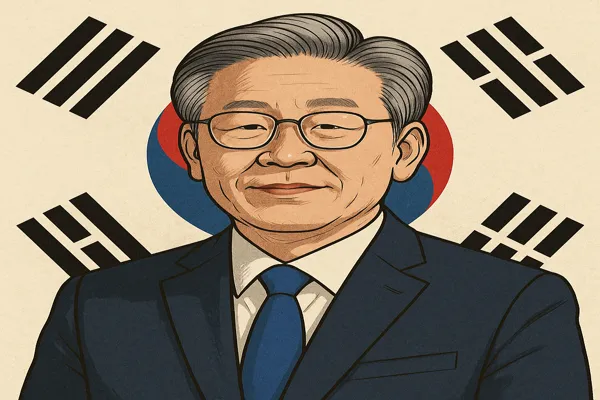
What It Means That Lee Jae‑myung Is Now South Korea’s President
What It Means That Lee Jae‑myung Is Now South Korea’s President
On June 3, 2025, South Korea held a snap presidential election after the impeachment of President Yoon Suk-yeol—who had imposed martial law in December 2024. The vote, seen as a referendum on democratic stability, resulted in Lee Jae-myung, a fiery former Gyeonggi governor and leading Democratic Party figure, becoming the new president with 49.4% of the vote.
Lee was sworn in just one day later, skipping the traditional transition period. It was a swift power shift—and one that carries deep political, economic, and diplomatic implications for South Korea and the wider region.
1. A Presidency Born from Crisis—and a Promise to Heal
Lee didn’t step into a calm presidency—he stepped into the eye of a political storm. His predecessor’s martial law attempt had shaken public faith in institutions. Lee responded with a strong message in his inauguration: he pledged to “heal the wounds of division” and govern with unity.
Rather than going on the attack, Lee presented himself as a restorer of democracy, promising to lead with transparency and bridge Korea’s bitter partisan divides. For many voters, this wasn’t just about choosing a candidate—it was about saving the system.
2. Economic Revival: First on the To-Do List
The South Korean economy is wobbly. Q1 showed contraction, and everyday essentials—from eggs to instant noodles—have gotten pricier. In response, Lee moved quickly:
He called for a supplementary budget to ease inflation and stimulate domestic demand.
He formed an emergency economic task force to assess urgent policy moves.
And he leaned into his economic philosophy of “Jalsanism”—a belief in universal basic welfare as essential infrastructure (like roads or electricity).
His focus is clear: prioritize real people and real problems. Supporters say it’s a long-overdue shift toward economic justice; critics warn it may stress public debt. Either way, Lee is not easing in—he’s sprinting from the start.
3. Balanced Diplomacy: Realism Over Rhetoric
Lee’s approach to foreign affairs is neither dogmatic nor overly idealistic—he's taking a centrist, realpolitik route.
With the U.S., Lee reaffirmed South Korea’s role in the alliance and initiated talks to ease recent trade tensions, including tariffs.
With China, he held a phone call with President Xi Jinping, expressing openness to deeper economic ties while still maintaining national autonomy.
With North Korea, Lee pledged to keep the door open for dialogue—but only under clear conditions related to denuclearization and peace.
With Japan, early signals point to a willingness to cooperate and strengthen trilateral ties.
Lee seems poised to act as a steady hand—engaging with global powers while firmly guarding national interest.
4. The Geopolitical Tightrope
This presidency begins at a time of real tension:
North Korea is accelerating missile tests.
China-U.S. rivalry is intensifying in the region.
South Korea is hosting major global events like the upcoming G7 summit.
Lee will need to walk a fine line: building military deterrence while staying open to diplomacy, aligning with allies while not alienating trade partners like China. It’s a high-stakes balancing act—and it will define Korea’s role in Asia.
5. 🕵️ Political Reform, Ethics—and the Shadow of Scandal
Lee’s presidency also arrives with baggage.
He has long framed himself as a reformer for the people, but his past is filled with legal and ethical controversy. The most notable include:
Daejang-dong scandal: A 2015 development deal in Seongnam made private investors huge profits. Critics accused Lee—then mayor—of turning a blind eye or worse. He denied involvement and escaped direct charges, but public suspicion lingered.
Baekhyeon-dong allegations: Another development project during Lee’s mayoral term raised questions of preferential treatment, though again, no conviction followed.
Election law violations: Lee was indicted in 2022 for allegedly lying during a debate about his brother’s involuntary hospitalization. The case was postponed indefinitely once he became president, due to constitutional protections.
His wife’s misuse of funds: Kim Hye-kyung was accused of using public funds for private expenses while Lee was Gyeonggi governor. Though the case settled with a fine for her aide, it fed opposition narratives.
To supporters, these were overblown or politically motivated attacks. To critics, they were red flags. Either way, they’re not forgotten—and Lee’s ability to govern with integrity and restraint will be under constant public scrutiny.
6. Social Vision: Toward a “Basic Society”
Beyond the economy, Lee has bigger ideas: a more equal, socially secure Korea.
He’s pushing the concept of a “basic society,” where citizens enjoy:
Universal healthcare
Basic housing
Basic income
Free education and digital access
In short, a Korea where nobody is left behind.
He’s also focused on green innovation, AI, and cultural soft power. (He even congratulated Korean creators winning Tony Awards—clearly aware that culture is part of policy, too.)
7. Challenges Ahead
Lee’s honeymoon will be short. These are just a few of the hurdles ahead:
Economic Pressure, Sluggish growth, inflation, U.S. tariffs—he must navigate carefully
Legal Backlash, Scandals could return if immunity ends or investigations resurface.
Polarization, Healing division requires more than words. He must bring both sides to the table.
International Expectations, Allies will want clarity; rivals will test his resolve.
G7 Summit and Global Stage, Hosting puts South Korea under a new kind of microscope.
8. Final Take: A Crossroads Presidency
Lee Jae-myung didn’t win the presidency under ordinary circumstances. He’s a figure of hope, controversy, and complexity. But he now leads a nation eager for calm, growth, and fairness.
If he succeeds in balancing his vision with transparency, if he can build both consensus and confidence, Lee’s presidency could reshape Korea’s future. If not, it could deepen distrust in institutions already strained by years of scandal and division.
Either way, Lee’s next moves won’t just shape Korea—they’ll ripple far beyond it.
